

There are several maps, guidebooks and leaflets in the drawer in the bureau in the hall for your use.
Timanfaya National Park

The greatest recorded eruptions occurred between 1730 and 1736. The volcanic activity continues as the surface temperature in the core ranges from 100 to 600 °C at the depth of 13 metres (43 ft), which is demonstrated by pouring water into the ground, resulting in a geyser of steam which is an attraction for tourists. There is only one active volcano, Timanfaya volcano which the park is named after.
more on Timanfaya National Park
Cave of Los Verdes
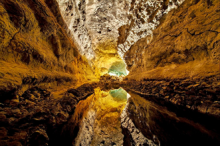
The cave was created around 3,000 years ago by lava flows erupted from the nearby volcano Monte Corona, flowing across the Malpaís de la Corona toward the sea. The lava streams cooled on top, developing a solid crust, before the lava drained away leaving the top part as the roof of a cave. In about 20 spots, the roof of the cave collapsed, forming a cavern known locally as a jameo. The caves extend for 6 kilometres (3.7 mi) above sea level and for another 1.5 kilometres (0.93 mi) below the sea (the Tunnel de la Atlantida).
Jameos del Agua
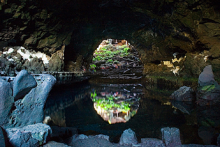
The Jameos del Agua is part of the Monumento Natural del Malpaís de la Corona which protects the site which is also listed as one of scientific interest, only last year a new species was discovered living in the tunnel that was named after César Manrique.
El Golfo and Los Hervideros
This coastal area has an abundance of underwater caves produced by the solidification of lava and erosion. Los Hervideros refers to the amazing display that sees the waves force water into the labyrinth of caves with such a dramatic power it appears as if the sea is bubbling and boiling. Visitors can wander around pathways in the cliffs and watch the display below.
The Cactus Garden
The Cactus Garden was created by local artist, the late Cesar Manrique, and features an impressive collection of Cacti and sculptures and a restored Windmill. The Cactus Garden is in Gautiza, in the north of Lanzarote and brings together more than 1,400 species of cacti from all over the world. It is easily recognizable from the road by the giant metallic cactus sculpture at the entrance, this cactarium was the last work carried out by César Manrique on the island. Visitors who enjoy nature will delight in strolling along cobbled paths whilst enjoying the landscape of Lanzarote in this peaceful place.
Castillo de San Gabriel
The Castillo de San Gabriel (Castle of Saint Gabriel) is located on a tiny island called Islote de los Ingleses (Islet of the English), which can be reached by two causeways, one for traffic and one for pedestrians. On foot, you pass over the Puente de las Bolas (Ball Bridge), a small drawbridge with two cannonballs on top of its pillars.
Built originally as a wooden fortress, it proved completely insufficient for any defence purposes and was eventually burnt down by Berber pirates.
It was then replaced by a stone castle in the 16th Century, finally playing a vital role in the protection of the harbour and the town. The fortress was declared a National Historic Monument in 1972 and houses a small ethnographic museum. The views from here over the city and the Atlantic Ocean are magnificent.
read more on Castillo de San Gabriel
Mirador del Rio
Mirador del Río is a viewpoint situated on an approximately 475 meters high escarpment called Batería del Río in the very north of the Canarian island of Lanzarote. The location was created in 1974 by the local artist César Manrique in his typical style, consisting of a balustraded cafe, a souvenir shop and a platform on its top which are integrated in the lava rock.
Mirador der Río provides a view over the strait of "Río" (naming the viewpoint) towards the archaic island of La Graciosa.
From here guards watched for secretly landing ships in former times. Its interiors and balcony areas were used as a location for the BBC television programme Doctor Who's serial, Planet of Fire, representing an alien planet and culture.
